What is an AI employee? A practical definition
An AI employee owns a job, not a task: it works a schedule, uses real tools, and escalates when unsure. What that means for a small business in 2026.
"AI employee" is having a moment, and most definitions come from enterprise vendors selling to companies with ten thousand staff. Here's the version that matters if your company has one to ten people: an AI employee owns a job, not a task.
A chatbot answers when spoken to. A copilot helps while you work. An agent completes a task you hand it. An AI employee is the next step up the ladder: it holds an ongoing responsibility, works on a schedule whether or not you're watching, and comes to you when something needs a human call.
The test is simple. If you stopped showing up for two weeks, would the work still happen? For a copilot, no. For an AI employee, yes, and you'd come back to a report rather than a fire.
The four things that make it an employee
1. It owns outcomes, not prompts
You don't tell an AI employee "write a blog post." You tell it "you own organic traffic," and it plans topics, writes drafts, publishes on schedule, and watches what ranks. The unit of work is the responsibility, not the request.
2. It uses real tools
An employee that can only talk is a consultant. AI employees hold credentials and act: they push code, file support replies, adjust ad budgets, read dashboards, open incidents. That's also what makes guardrails non-negotiable, which we'll get to.
3. It works a schedule
Monitoring runs around the clock. Content ships weekly. Metrics get reviewed daily. None of it waits for you to remember to ask. The value isn't intelligence; it's coverage. A mediocre check that runs every hour beats a brilliant one that runs when you're stressed enough to think of it.
4. It escalates
This is the trait everyone skips and the one that separates a useful AI employee from a liability. Good ones know their limits: refund over $50, unclear legal question, deploy that might break checkout. They stop and ask. A human employee who never asked questions and never flagged problems would scare you. Same rule here.
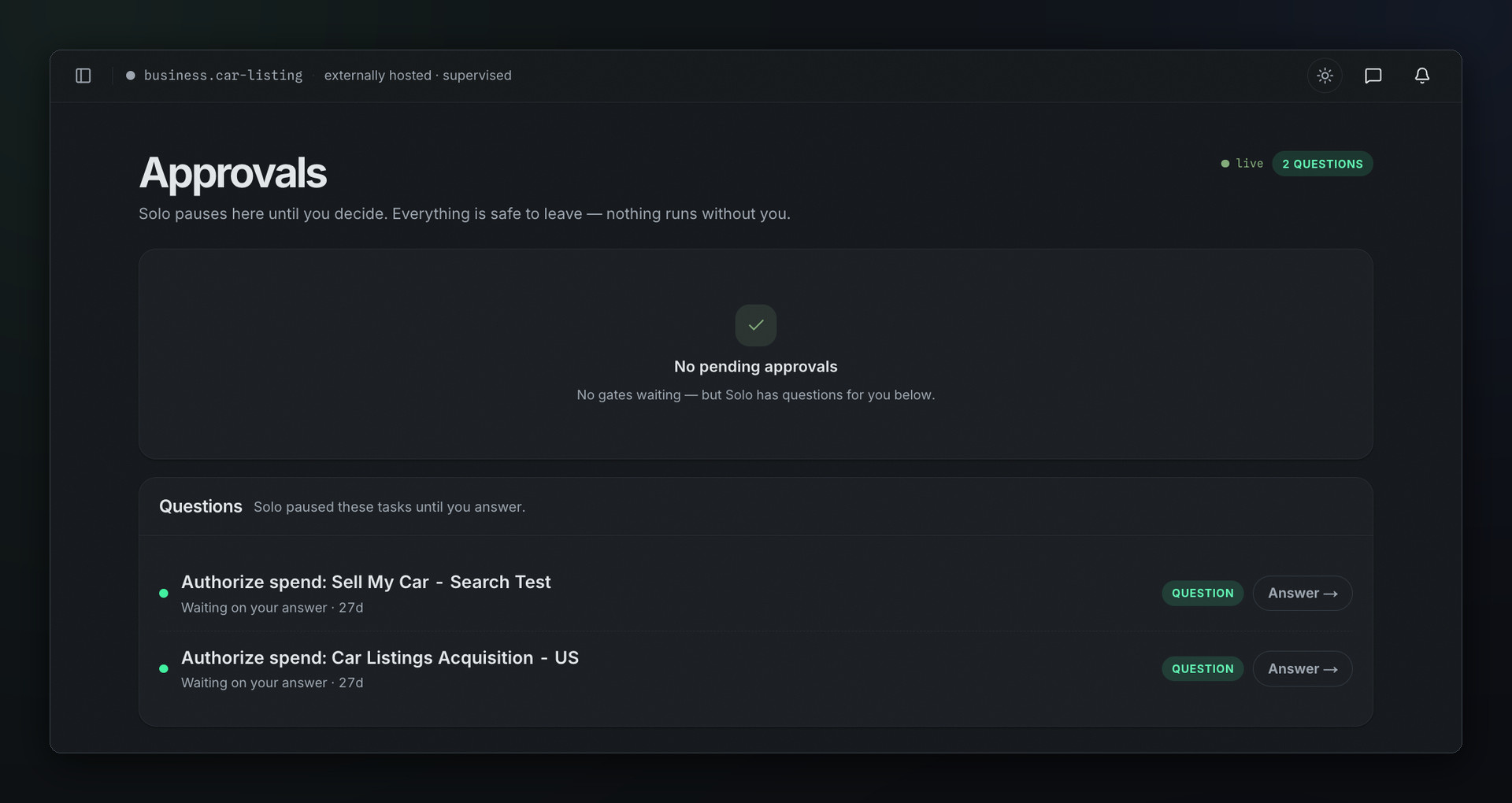 When Solo asks, it stops. Both campaigns are waiting for a human to authorise the spend before money moves.
What AI employees actually do well in 2026
- Support triage. Read every ticket, answer the routine half, draft replies for the rest, flag the angry ones. First response in minutes instead of hours.
- Content and SEO operations. Keyword research, drafts, internal links, publish cadence, rank tracking. The grind that most one-person companies simply skip.
- Monitoring and incident response. Watch health checks, correlate an alarm with the deploy that caused it, roll back, write the timeline. At 3am, without resentment.
- Routine engineering. Dependency updates, test runs, small fixes with review gates. Not the architecture; the upkeep.
- The books, almost. Invoice chasing, reconciliation drafts, spend summaries. Sign-off stays human.
Notice a pattern: bounded jobs with verifiable outcomes. The ticket got answered or it didn't. The site is up or it isn't. That's where the current generation is genuinely dependable. Open-ended judgment (what should the product be, is this partnership smart) is still your job, and honestly, that's the job you wanted to keep.
What it costs, roughly
A junior operations hire costs a salary plus the management time to direct it. The model and tooling spend for the jobs above is a small fraction of that, and it scales with the work rather than with headcount. That math is why this category exists. It's not that AI is better than people; it's that at this price, jobs that never justified a hire (24/7 monitoring for a $2k/mo product, daily SEO ops for a micro SaaS) suddenly get done at all. The function-by-function playbook says which of those jobs to hand over first.
The guardrails are the product
Giving software credentials to your Stripe account concentrates the mind. The difference between an AI employee and a script with an API key is the supervision structure around it:
- Approval gates on money, deploys, and anything customer-visible
- Budgets and rate limits it cannot raise for itself
- An audit trail of every action, reviewable later
- A defined escalation path when confidence is low
- Rollback for anything it can change
If a vendor selling you an "AI employee" can't show you those five things, they're selling you the script with the API key.
Where this is heading
The enterprise version of this idea is about carving thousand-person processes into agent-run domains. The more interesting version, to us, runs the other direction: one founder, one product, and an AI employee handling the operations layer that used to require a first hire. The org chart stays flat. The founder does product and talks to customers. The rest runs on a schedule, with receipts.
That is the division of labour we run ListMyCar.ai on. The owner sets direction, chooses goals, talks to customers, and approves consequential decisions. Solo tracks what is happening, proposes the next move, plans and runs the work, verifies the outcome, and records what it learned. From April through August 2026, more than 50 people created a listing, and every task, pause, and failure along the way stayed in the record. The case study shows both sides of the arrangement.
Solo is an AI employee for your software business. It assembles your product on a standard stack, then owns the operations: deploys, monitoring, incidents, marketing. Everything gated, logged, and reversible. You hear about it when it matters. Join the waitlist →