AI agents for business, minus the hype
AI agents for business in 2026: what they reliably do, where they still fail, and the guardrails that separate useful autonomy from an expensive incident.
AI agents are useful to a business in a narrower and more interesting way than the marketing says: bounded jobs with verifiable outcomes, wrapped in a management layer that supplies the doubt the model lacks. We run them in production every day, deploying code, watching infrastructure, writing content, and triaging incidents for the businesses Solo operates, including ListMyCar.ai. So consider this the field report, not the keynote.
What an agent actually is
Strip the branding and an agent is a loop: it has a goal, it can use tools (run code, call APIs, read dashboards, send messages), and it checks its own progress and tries again until the goal is met or it gives up. That last clause is the whole difference from a chatbot. A chatbot answers you. An agent goes away and does something, and comes back with either a result or a question.
The loop is simple. The consequences aren't, because "can use tools" means "has your credentials," and that changes how you think about everything downstream.
Where agents deliver, today
A pattern shows up across everything that works: bounded jobs with verifiable outcomes. The task has a clear finish line, and success can be checked mechanically. Ticket answered. Tests green. Site up. Post published.
- Support triage. Read every incoming message, resolve the routine ones, draft the rest for review, escalate anything angry or legal. This is the most mature use case in the field, and the deflection numbers vendors quote (half of tickets or more) match what we see for products with decent docs.
- Content operations. Not "write my blog," but the pipeline around it: keyword research, briefs, drafts against a style guide, internal links, publish on schedule, track what ranks. Humans keep taste; agents keep cadence.
- Monitoring and first response. Correlate the alarm with the deploy that caused it, roll back, open an incident with a timeline attached. Minutes matter at 3am, and agents don't sleep.
- Routine engineering. Dependency bumps, flaky-test hunts, small well-specified fixes, each behind a review gate. The upkeep layer of a codebase, not its architecture.
- Structured research. Competitor pricing sweeps, lead list enrichment, market scans. Anything that's an afternoon of tabs for a human.
Where they still fail
Knowing the failure modes is worth more than knowing the success stories, because the failures are what you'll debug.
- Open-ended goals. "Grow revenue" produces motion, not progress. An agent needs a goal you could hand a contractor with a straight face.
- Irreversible actions without gates. An agent that can email your whole customer list, delete data, or spend ad budget without a checkpoint isn't automation; it's a loaded risk register.
- Long-horizon coherence. Agents drift across weeks-long projects. The fix is structure: break work into checkpointed stages with verification between them, rather than trusting one heroic run.
- Knowing when they're wrong. Confidence and correctness still aren't correlated enough. The system around the agent has to supply the doubt: tests, budgets, reviews, escalation rules.
The guardrails are where the engineering lives
Everyone's models are good now. The difference between a production agent system and a demo is everything wrapped around the loop. Ours, distilled:
- Approval gates on money, deploys, external messages, and anything customer-visible
- Hard budgets (spend, time, retries) the agent cannot raise for itself
- Verification before "done": platform-owned checks pass and an independent reviewer validates the result
- An audit trail of every action and why, reviewable after the fact
- Escalation as a feature: when confidence is low, stop and ask a human, and make asking cheap
- Rollback for every change class the agent can make
Notice these are management structures, not model features. Running agents well feels less like installing software and more like onboarding a fast, tireless, occasionally overconfident junior hire. The companies getting value from agents are the ones that built the management layer.
What it looks like in production
On ListMyCar, a goal is the unit of work. The owner accepts a suggestion or writes a goal; Solo turns it into an ordered plan; a separate reviewer checks the plan before the owner approves it. Then each task runs in an isolated workspace, passes the repository's checks, and is reviewed independently before it lands. Publishing, campaign activation, production deploys, and destructive changes stop at a gate and wait.
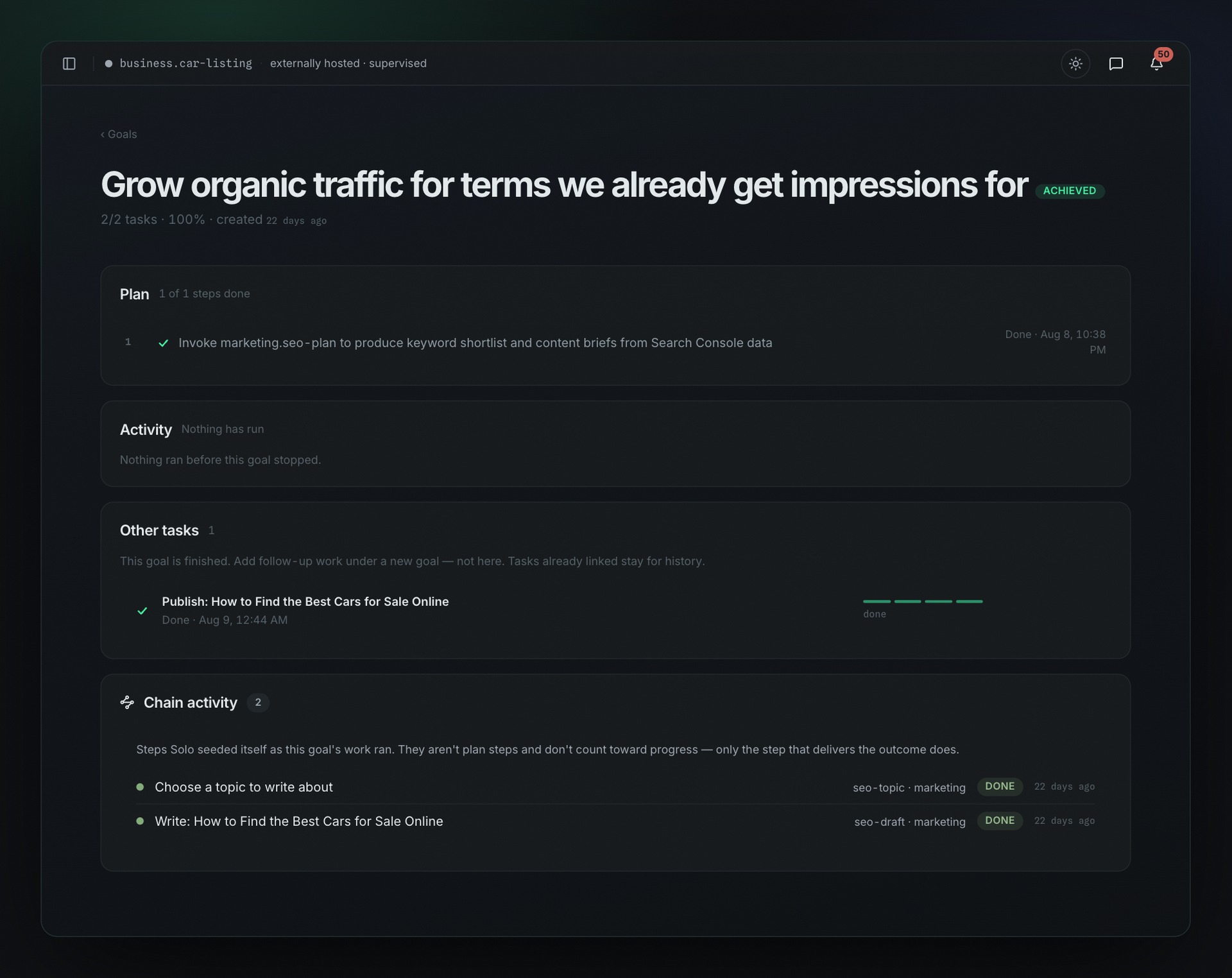 One goal end to end: the plan step, the task that delivered it, and the chain steps Solo seeded itself as the work ran. Progress, pauses, and failures all stay part of the record.
The record is the point. A failed deploy attempt stays visible beside the one that succeeded, a failed plan step stays in the plan, and an incident opens with the release context attached. None of that makes the agents smarter. It makes them safe to leave running, which is the property that actually matters. The case study shows the loops and what they measured from April through August 2026.
Build or buy?
The frameworks make "build" look like a weekend. The guardrail list above is why it isn't: the loop is 10% of the work and the supervision is the other 90%. Our honest rule of thumb:
- Build when the job is unique to your business and sits on proprietary data or workflow.
- Buy when the job is universal: support, monitoring, content cadence, deploy hygiene. You're not the first, and the guardrails come included. Which functions to hand over first is its own question.
For a one-person company, the calculus tilts hard toward buy. Your scarce resource is attention, and building agent infrastructure spends it on exactly the layer a platform can own. The point of an AI employee is to give you hours back, not a new codebase to babysit.
Solo ships the agents and the management layer. Deploys, monitoring, incidents, and marketing run as gated, budgeted, audited agent jobs on the businesses Solo assembles. You approve what matters; everything else keeps moving. Join the waitlist →